
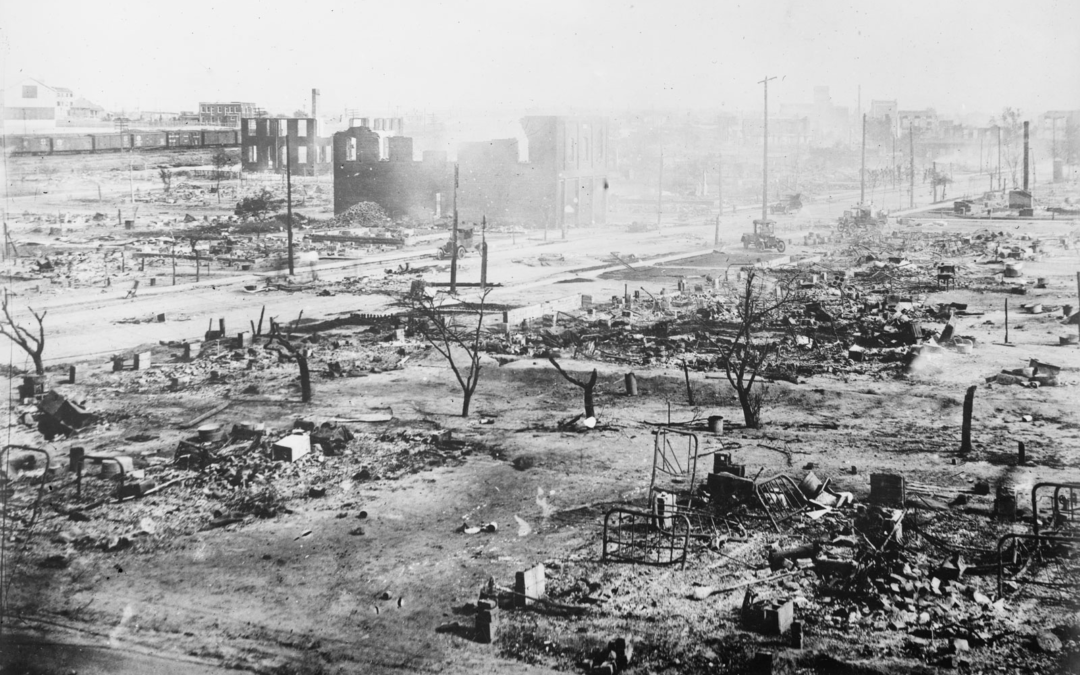
One doesn’t have to grow up in America for very long to discover that our public education system is beyond lacking, especially when it comes to sharing our history. Downplaying the truth, or flat out ignoring it, seems to be our way when we don’t want to face our past as a country. Of course, this only breeds ignorance, and an inability to learn from tragedies that could’ve been avoided. One such tragedy that has slipped under the radar for far too long was the Tulsa race massacre of 1921.
All it takes is a quick Google search to learn the ins and outs of what happened. In summary, an angry white mob killed more than 300 Black citizens over the course of two days (May 31-June 1) in the Greenwood District of Tulsa, Oklahoma. In addition to these murders, the mob destroyed what was known as Black Wall Street—a large, Black-led community of creative minds, entrepreneurs, and business owners. The rioters dropped bombs, torched houses, and slaughtered men, women, and children as acts of senseless violence. To this day, there’s still no accurate death toll, and the community has continued searching the city for the bodies that were dumped and buried. Needless to say, not one of the murderers has been brought to justice.
I’m fortunate enough to have visited the city in July 2020 and volunteered with the Vernon A.M.E. Church. It’s one of the oldest standing buildings in Tulsa to have survived the bombings and fires, and they used its basement as a haven and hiding place during those terrifying two days. I owe most of my knowledge of the event to Reverend Robert Turner, Vernon’s pastor and an accomplished Black rights activist. He shared stories of families and entrepreneurs struggling to rebuild and move on with their lives after receiving little to no help from the government, let alone insurance companies; of how the community had to pool their own resources and lift each other up, as they only had one another to rely on.
I can’t say enough about all the good Rev. Turner has done for the community: offering tours of the church to educate visitors on its history by showcasing the basement and the fire damage done to it, and leading peaceful protests weekly to City Hall demanding justice and reparations for the event—all to benefit Greenwood and the community. During my visit, I was able to be a part of all of it and explored the remnants left behind from 1921. I’ll never forget driving by a digging site where they hoped to recover the victims’ bodies.
Now that it’s the 100-year anniversary, I am happy to see Greenwood making waves once again, with numerous documentaries airing on a variety of channels about the massacre and what has happened to Greenwood since then. It’s with much pride that I saw Rev. Turner featured as an interviewee/commentator addressing the history and talking about the need for reparations for the survivors and the descendants of the victims. Those willing to sign the petition for reparations can do so at change.org, titled “Reparations for 1921 Tulsa Race Massacre Survivors and Descendants.” As I write this, they are only about 3,500 signatures away from reaching their goal of 35,000. Rev. Turner also has a “Bless the Basement” GoFundMe campaign with hopes of raising money to restore the Vernon A.M.E. Church.
If you knew about the race massacre before these last couple of years and didn’t live in the Greenwood District, consider yourself lucky—it’s a part of history that unsurprisingly went untaught for years, even within Tulsa’s own universities. I look forward to the day where we don’t have to rely on devastating tragedies to open up society’s eyes about human rights. But until then, all we can do is try to make strides and grow as a nation. We could all take notes from the Black Wall Street community who extended their hands to one another and continued to make their businesses thrive despite the suffering grafted into the bricks and asphalt of the city.
Greenwood Rise.
penned by Diva Ferrell